

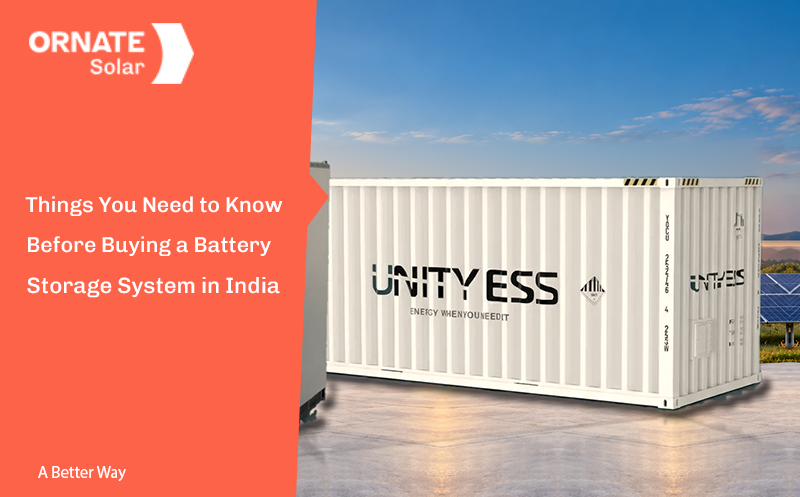
India is moving from announcing battery storage projects to actually building them. The Central Electricity Authority estimates the country will need about 47 GW and 236 GWh of battery storage by 2031-32. That means thousands of businesses, developers and lenders will soon make a buying decision they’ll live with for two decades.
Here’s what you should look at before you sign.
Why India needs Energy storage system
A battery energy storage system (BESS) runs for 15 to 20 years. Its value isn’t decided on the day it’s installed. It’s decided by how it performs years later.
The company that understands how a battery behaves in year seven, not year one, is the one that owns the relationship with the customer and the performance of the asset. That knowledge can’t be bought or licensed. It’s earned in the field.
1. You’re buying a 15 to 20 year asset, so judge it by year seven
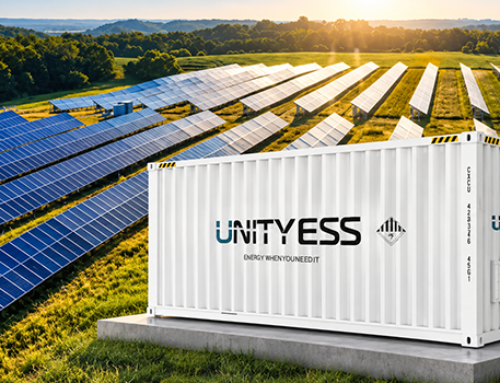
UnityESS is a joint venture of Ornate Solar and Inverted Energy that designs, builds, commissions and monitors battery energy storage system in India. We do not sell boxes. We take a project from load profile to year twenty, with one team.
Ornate Solar has deployed 1 GW+ of solar for 7,100+ customers. Inverted Energy, founded by IIT engineers, runs three factories with 6.5 GWh of annual battery capacity. Our systems are made in Ghiloth, Rajasthan.
2. The cells are imported. The real difference is everything built around them
UnityESS imports its cells from China, and so does every other Indian BESS company, whatever the marketing says. China’s lead comes from two decades of building its capability in cell materials and the machinery that makes them, and from running plants so large that improving yield is continuous.
What Indian companies can realistically close within five years is everything above the cell:
- How the system is put together (system integration)
- How it’s kept cool (thermal design)
- The software that controls and protects it (BMS and EMS)
- How carefully it’s switched on and tested at site (commissioning)
- How well it’s looked after for 20 years (lifetime service)
3. “Made in India” is a label. Traceability is a test
Traceability means the company can show the full history of every major part in your system. A buyer should be able to ask for an unbroken chain covering:
- Cell batch and production lot
- Module and pack serial numbers
- Which racks and clusters each module sits in
- Firmware version (built-in software) of the battery management system
- Serial number and firmware of the power converter (PCS)
- The cooling unit
- The fire detection and suppression panel
- A factory acceptance test record tied to each of the above
The weakest visibility in India today is one level deeper: the parts inside the power converter, the sensors inside the cooling system, and the software. Firmware is barely checked in Indian purchasing today, yet it’s the part most likely to change quietly over 20 years.
4. Cells should be chosen for your site, not picked off a shelf
Traceability starts before the cells are even made. At UnityESS, cell details such as chemistry, format, charge and discharge rate, internal resistance and safe temperature range are chosen to match the site’s climate, how hard the battery will work each day, and what it’s being used for. They’re specified before manufacturing begins, not selected from stock afterwards.
A cell built to a clear specification can be checked against that specification later.
5. The honest battery life today is 10,000 cycles
A cycle is one full charge and one full discharge. Here’s how lithium iron phosphate (LFP) cells, the standard for storage, have improved:
- Early storage cells: about 5,000 cycles
- 280 Ah cells: about 6,000 cycles
- Today’s 314 Ah and larger cells: close to 10,000 cycles, with a 20-year design life
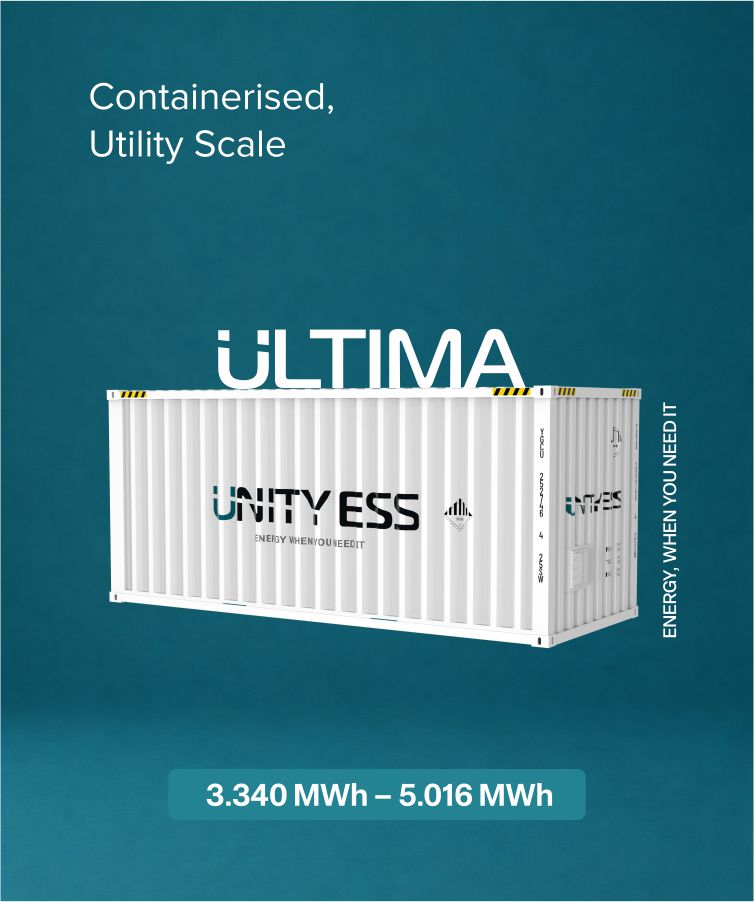
This progress is why a standard 20-foot container has grown from about 2.5 MWh to more than 5 MWh in under five years without changing size, though it has become heavier.
The next generation, cells above 587 Ah, promises around 12,000 cycles. UnityESS doesn’t accept that figure as a bid assumption until it has been properly tested in India.
6. The evidence to demand before you trust the numbers
- Cells tested at their rated charge rate and at your site’s real temperature range, not only in lab conditions.
- Round-trip efficiency measured at the AC terminals, with auxiliary power included. Efficiency is how much energy you get back. The honest figure counts the power used by cooling and controls, not just the battery-side number.
- Degradation curves from batteries already running in the field, not predictions stretched out from cell-level tests. Degradation is how fast the battery loses capacity.
- Independent test reports and a clear plan for testing at switch-on and every year after, with a written remedy if performance falls short.
7. “Designed for India” means more than handling heat
Heat is the easy part. The tougher challenges never appear on a global spec sheet:
- Grid behaviour. Indian industrial power lines see swings in voltage and frequency, electrical noise and sudden switching events. Protection settings tuned for other countries can cause unnecessary trips here, and a battery that trips earns nothing.
- How it’s used. Batteries abroad are often designed for one deep cycle a day. An Indian commercial or industrial battery often does several partial cycles a day: shifting power to cheaper hours, cutting peak demand charges, smoothing solar output and providing backup, often all four. That affects cooling design and cell choice, not just software.
- Environment. Dust, monsoon humidity and coastal salt mean the enclosure is the battery’s only protection for 20 years.
- Service reality. Spare parts, response times and the fact that no specialist engineer will be on site when something goes wrong all need to be planned for.
8. Paying monthly? Check these three things in the contract
Battery-as-a-Service lets you pay as an operating expense instead of buying upfront. UnityESS already works across ownership, OPEX, Build-Own-Operate and Build-Own-Operate-Transfer models. The problem isn’t demand. It’s that Indian contracts have no standard way to put a price on a battery’s condition. Three things need to change:
- Battery health must be measured, not self-reported. The contract should define the test method, where it’s measured and how often it’s audited.
- Residual value needs a reference price. Until there’s a working second-life and recycling market for cells at about 70% health, lenders are backing an asset with no clear exit.
- Risk should sit with whoever controls how the battery runs. If the company operates it, the company carries the risk of it wearing out. If the customer decides how it runs, the risk moves to the customer. Most disputes come from contracts that blur this.
9. Some rules in India still aren’t standard
Policy has moved fast, but measurement hasn’t kept up:
- There’s no single national method to verify capacity, efficiency and response time at switch-on and every year after.
- Grid connection rules differ between states and electricity distribution companies.
- Reports on availability and degradation have no standard format.
- Energy accounting rules differ from state to state, so the same project can have a very different business case across a border.
- Safety standards such as IEC 62933 and UL 9540A already exist, but India’s local rules lag behind. Making full-system fire testing mandatory now is far cheaper than bringing in rules after the first serious incident.
10. Don’t buy on unverified paper
The biggest mistake in Indian BESS buying today is signing contracts on claims no one has checked, such as 12,000 cycles, 95% efficiency and 2% yearly degradation. These figures go straight into financial models. When they turn out wrong, the reliability and safety risk usually surfaces around year six, long after the purchase team has moved on.
Every bid should come with:
- Independent test reports at rated conditions
- Full traceability from cell batch to finished system
- A defined commissioning test
- Yearly performance checks with a stated remedy for shortfalls
None of this needs a new institution. The CEA, BIS and certification bodies already have the authority. What’s missing is a rule that proof must come with the bid, not after it.
Then let price decide. Competing on price is healthy when the numbers are verified. Competing on unverified claims just pushes the risk onto whoever owns the battery in year ten.
Where UnityESS stands
UnityESS is Built for India. Our engineering team has spent over a decade building, deploying, and fixing systems in Indian conditions, so the failures we design against are Indian. Our view is simple: India is building a storage fleet that will outlast most of the people buying it, so the time to be rigorous is now.
Learn more at www.unityess.ai
Common FAQs
About Ornate Solar
Ornate Solar is a leading solar company with 10 years of experience in the industry and the mission to reimagine the way solar is installed worldwide.
By not only partnering with the best-in-class solar brands but also developing our high-quality solutions (panels, solar inverters, accessories, InRoof), we develop and deliver solutions that are modern, reliable, and effective.
Ornate Solar is also a trusted BESS manufacturer in India. We have developed UnityESS, an advanced energy storage solution to provide reliable power and energy independence.
If you are looking for high-quality solar solutions, call us at 1800 2026 252 to discuss your options.




Leave A Comment