

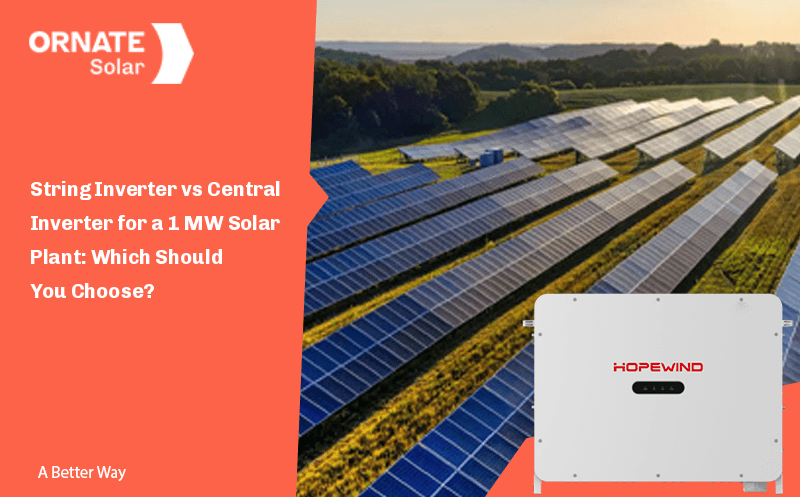
For a 1 MW ground-mounted solar plant, a high-capacity string inverter is usually a better choice than a central inverter. Three Hopewind 385kW string inverters can cover a 1 MW plant with 24 MPPTs, no DC combiner boxes and no single point of failure, delivering higher energy harvest, better uptime and easier maintenance.
From PM-KUSUM Component A plants on farmland to open-access projects and captive plants for industries, 1 MW has become one of the most common project sizes in the country. At this scale, one decision quietly shapes the plant’s performance for the next 25 years: the choice of inverter.
So should you choose a central inverter or a string inverter? And how much does a 1 MW plant actually cost? Let’s break it down.
Central Inverter vs String Inverter: What’s the Difference?
Both inverters do the same job. They convert the DC power from solar panels into AC power for the grid. The difference lies in how the plant is designed around them.
What Is a Central Inverter?
A central inverter is one large unit that handles the power of the entire plant. Module strings are first joined together inside DC combiner boxes in the field, and heavy DC cables then carry the combined power to the inverter, which usually sits in a container or inverter room along with the transformer and switchgear.
Central inverters are a mature technology and can offer a lower equipment cost per watt on very large solar parks. However, they track a large array through only a few MPPTs, need a crane for installation, and depend on skilled technicians for repairs.
What Is a String Inverter?
In a string inverter design, module strings connect directly to the inverter’s own inputs, with no DC combiner boxes in between. The AC output of each inverter is then collected and sent to the transformer.
Earlier, string inverters were small, so large plants needed dozens of them. Today, utility string inverters like the Hopewind 385kW handle hundreds of kilowatts each, combining the simple layout of a central design with the flexibility of a string design.
| Factor | Central Inverter | String Inverter |
|---|---|---|
| Unit capacity | Typically 2.5 MW and above | Hundreds of kW (e.g. Hopewind 385kW) |
| MPPTs | Few (typically 1 to 4) | Many (8 per Hopewind 385kW) |
| DC combiner boxes | Required | Not Required |
| Impact of one fault | Large part of the plant offline | Only that inverter’s section offline |
| Installation | Pad or skid with crane lift | No inverter room or container |
| Servicing | On-site repair by specialists | Quick unit replacement |
| Monitoring | Array or zone level | String level |
2. OPEX (Operational Expenditure) Model:
The OPEX (Operational Expenditure) model transfers the responsibility of the solar plant to a third party, addressing the limitations of the CAPEX model.
A consumer who wants to switch to clean energy but doesn’t have the capital ready to make the transition can ask a Renewable Energy Service Company (RESCO) to set up a solar plant.
The consumer provides the space, and the developer invests in the equipment, installation, commissioning, and maintenance of the plant. This type of installation is also called a land lease model.
The OPEX model works on a pay-per-use basis, where the customer only pays for the electricity produced by the solar system.
In India, green energy open access is available to all C&I consumers with a load demand of 100kW or higher.
Key Features:
- No large upfront costs.
- Customer only pays for the energy generated.
- Solar service provider manages installation, maintenance, and operations.
Ornate Solar’s Ground-Mounted Success Stories
Ornate Solar has carved a niche in the solar industry by delivering innovative and efficient solutions. Two landmark projects include:
1. 10 MW Solar Plant | Industry: FMCG
A trusted household name partnered with us to power its operations sustainably, reflecting a strong commitment to renewable energy and operational efficiency.
2. 10.25 MW Solar Plant | Industry: Automotive
A leading automotive parts manufacturer joined hands with Ornate Solar to meet energy demands while significantly reducing its carbon footprint.
These projects not only showcase Ornate Solar’s expertise but also highlight how diverse industries are embracing solar power to transform their energy consumption patterns.
Subsidies on Ground-Mounted Solar Power Plants
The Indian government has introduced several incentives to encourage the adoption of solar energy:
- Central Financial Assistance (CFA): Up to 30–40% of project costs for eligible projects.
- Tax Benefits: Commercial and industrial solar installations can avail up to 40% accelerated depreciation on their solar plant.
- Custom Duty Exemptions: On specific solar components and equipment.
- Net Metering Policies: Allow businesses to sell excess electricity to the grid, creating an additional revenue stream.
These subsidies and incentives make ground-mounted solar installations even more attractive for businesses.
Subsidies on Ground-Mounted Solar Power Projects in India Under PM-KUSUM
The Pradhan Mantri Kisan Urja Suraksha evam Utthan Mahabhiyan (PM-KUSUM) scheme is a flagship initiative by the Government of India to promote solar energy adoption, particularly in rural areas. This scheme offers significant subsidies for ground-mounted solar power projects, encouraging farmers, cooperatives, and local bodies to participate in the renewable energy transition. Here’s a breakdown of the benefits under this scheme:
Component A: Decentralized Ground-Mounted Solar Projects
- Capacity: Up to 2 MW on barren/agricultural land.
- Benefits: Farmers can lease land for solar plants, earning a steady income while retaining ownership.
Component C: Feeder-Level Solarization
- Capacity: Projects start at 500 kW.
- Subsidy: Farmers receive up to 30% subsidy, with the remaining 70% covered by bank loans.
Benefits for Stakeholders
At Ornate Solar, we understand that transitioning to renewable energy is a significant step. That’s why we provide:
-
Customizable Solutions:
Tailored to the energy needs of your industry.
- End-to-End Support: From feasibility studies and design to installation and maintenance.
- Premium Quality Products: Backed by advanced technology for maximum efficiency and durability.
- Financial Assistance Guidance: Helping you navigate government subsidies and other financial benefits.
Whether you’re in FMCG, automotive, or any other sector, Ornate Solar is your trusted partner in building a sustainable future.
Common FAQs
Conclusion
Ground-mounted solar projects are transforming India’s industrial and commercial energy landscape. With substantial cost savings, government support, and growing awareness of sustainability, there has never been a better time to go solar.
Partner with Ornate Solar to make your transition seamless, efficient, and impactful. Let’s illuminate your journey towards a greener future!
About Ornate Solar
Ornate Solar is a leading solar company with 10 years of experience in the industry and the mission to reimagine the way solar is installed worldwide.
By not only partnering with the best-in-class solar brands but also developing our high-quality solutions, (panels, inverters, accessories, InRoof), we develop and deliver solutions that are modern, reliable, and effective.
If you are looking for high-quality solar solutions, reach out to us at 011 43536666 to discuss your options.










Leave A Comment