

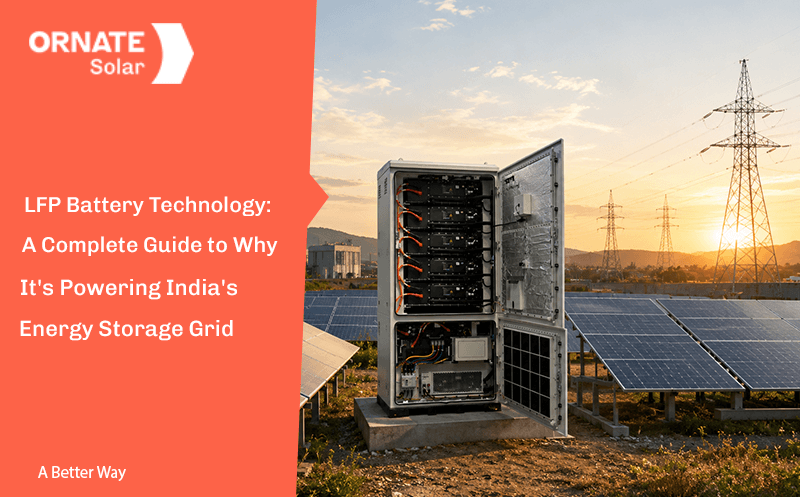
An LFP battery (Lithium Iron Phosphate, chemical name LiFePO₄) is a lithium-ion battery that uses iron and phosphate instead of cobalt or nickel in its cathode. It trades a measurable amount of energy density for major gains in safety, cycle life, and cost — which is why LFP now accounts for roughly 75% of India’s installed BESS capacity, and why it’s the chemistry the country’s storage buildout is being built around.
What is BESS and How Does It Work?
Every lithium-ion cell — whether it’s in your phone, an EV, or a shipping-container-sized BESS unit — has the same four parts: a cathode (positive electrode), an anode (negative electrode, almost always graphite), an electrolyte, and a separator sitting between the two. During charging and discharging, lithium ions physically move back and forth between the cathode and anode through the electrolyte, while the thin polymer separator keeps the two electrodes from touching and short-circuiting.
Here’s the part that actually matters for anyone comparing batteries: the anode, electrolyte, and separator are broadly similar across lithium-ion chemistries. The one component that changes — and the one that defines everything else about the battery — is the cathode material. Swap the cathode, and you get a battery with a different safety profile, a different lifespan, and a different cost structure, even though it’s still technically “lithium-ion.”
This is why “lithium-ion battery” is a misleading catch-all. It’s a family of chemistries, not one battery. The three that matter for EVs and stationary storage today are LFP, NMC, and NCA.
The Three Cathode Chemistries, Compared
| Features | LFP (Lithium Iron Phosphate) | NMC (Nickel Manganese Cobalt) | NCA (Nickel Cobalt Aluminium) |
|---|---|---|---|
| Key cathode materials | Iron, phosphate | Nickel, manganese, cobalt | Nickel, cobalt, aluminium |
| Energy density | Lower (~20% less than NMC) | Higher | Higher |
| Typical cycle life | 4,000–6,000+ cycles | 1,000–2,000 cycles | ~1,000–2,000 cycles |
| Thermal runaway onset | High — roughly 270°C | Moderate — roughly 210°C | Moderate |
| Cost per kWh (2025 global avg., pack) | ~$81/kWh | ~$128/kWh | Similar to NMC |
| Cold-climate performance | Weaker | Stronger | Stronger |
| Cobalt/nickel dependency | None | High | High |
| Best fit | Grid storage, C&I BESS, stationary applications | Long-range EVs, space-constrained applications | High-performance long-range EVs (e.g. Tesla) |
Why cost differs so structurally: iron and phosphate are among the most abundant elements on Earth, mined and processed widely with no serious supply-chain chokepoints. Nickel and cobalt are neither abundant nor evenly distributed — cobalt mining is concentrated in a handful of countries, and both metals carry price volatility that gets baked directly into NMC and NCA cell costs. This isn’t a manufacturing-efficiency difference; it’s a raw-material-economics difference, and it doesn’t disappear with scale.
Why cycle life differs so structurally: LFP’s cathode is built on an olivine crystal structure with strong phosphorus-oxygen (P-O) bonds. That structure holds its shape through repeated charge-discharge cycles far better than the layered-oxide structures in NMC and NCA cathodes, which develop micro-cracks and degrade faster under the same stress. Fewer structural cracks per cycle means the cell holds usable capacity for thousands more cycles before it needs replacing.
How an LFP Cell Is Actually Manufactured
Understanding the manufacturing process explains why LFP cells have become so cost-competitive at scale.
Electrode preparation: Iron phosphate cathode material and graphite anode material are each mixed into a slurry with a conductive additive and a binder, then coated onto thin sheets of aluminium (cathode) and copper (anode) foil.
- Calendaring and slitting: The coated foils are compressed to a precise density and cut into the widths needed for the cell format being built.
- Cell assembly: Depending on the format — cylindrical, prismatic, or pouch — the electrode sheets and separator are either wound together (cylindrical/some prismatic) or stacked in layers (pouch and most large-format prismatic cells used in BESS).
- Electrolyte filling and sealing: The assembled cell is filled with liquid electrolyte in a moisture-controlled dry room and hermetically sealed.
- Formation and aging: The cell undergoes its first controlled charge-discharge cycles, which forms a stable protective layer on the anode (the solid electrolyte interphase) — a step that directly determines the cell’s eventual cycle life. Cells are then aged and tested before being graded and shipped.
- Pack and container integration: Cells are assembled into modules, modules into racks, and racks into the containerized or cabinet-based systems that make up a finished BESS unit, along with the Battery Management System (BMS) that monitors voltage, temperature, and balancing at the cell level.
LFP’s simpler, cobalt-free cathode chemistry doesn’t just lower material cost — it also tolerates a wider manufacturing process window than nickel-rich cathodes, which require tighter humidity and contamination control. That translates into higher yields and lower defect rates at scale, reinforcing the cost advantage from a second direction beyond raw materials
The Large-Format Cell Race: Why Bigger Cells Keep Winning
BESS cell formats have grown rapidly in capacity: from 280Ah cells (the industry standard a few years ago) to 314Ah, and now to 587Ah and beyond. This isn’t a marketing number — it has real cost implications. A larger cell means fewer total cells needed for the same pack capacity, which means fewer inter-cell connections, less busbar and wiring, fewer thermal-management interfaces, and less BMS hardware per megawatt-hour. Fewer components translate directly into lower balance-of-system cost and faster assembly, on top of whatever cost reduction comes from the cell chemistry itself. Fastmarkets’ analysts expect 587Ah-class cells to become a mainstream BESS option through 2026, continuing the trend that took the industry from 280Ah to 314Ah in just a few years.
Why LFP Now Dominates Global BESS Deployment
1. Cost: The Iron-Phosphate Advantage
BloombergNEF’s 2025 Lithium-Ion Battery Price Survey put the global average LFP battery pack price at $81/kWh, against $128/kWh for NMC — a roughly 37% gap. Stationary storage specifically was the cheapest battery segment of any application in 2025, averaging close to $70/kWh, a 45% year-on-year decline driven almost entirely by the industry’s continued shift to LFP. BNEF expects prices to fall further through 2026 as adoption spreads and cell manufacturing overcapacity persists, particularly out of China.
This cost gap compounds at scale. A 100 MWh BESS project priced on NMC cells versus LFP cells can differ by several crore rupees in cell cost alone — before even factoring in the lower total cost of ownership LFP delivers through its longer cycle life.
2. Cycle Life: The Real Driver of Lifetime Economics
A “cycle” is one full charge and discharge. LFP cells commonly handle 4,000 to 6,000 cycles — some rated even higher — before capacity degrades meaningfully. NMC and NCA cells typically manage 1,000 to 2,000 cycles in comparable conditions.
Run the arithmetic: a BESS that cycles once a day hits 4,000 cycles in a little under 11 years. At 6,000 cycles, that’s over 16 years of daily use before the battery needs replacing. For a project financed over a 20–25 year Power Purchase Agreement (PPA) — which is how most Indian utility-scale storage is now contracted — this single number determines whether the asset needs one mid-life battery augmentation or none at all.
3. Safety: Why LFP Passes Fire Review Faster
LFP’s olivine crystal structure holds onto oxygen far more tightly than the layered-oxide structures in NMC and NCA, pushing its thermal runaway onset to roughly 270°C compared with roughly 210°C for NMC. Thermal runaway is the chain reaction that causes lithium-ion battery fires — it starts when a cathode releases oxygen under heat or physical stress, feeding the fire from within the cell itself. LFP’s chemical bonds resist that release at meaningfully higher temperatures.
For a BESS specifically, this isn’t an abstract safety statistic — it’s what gets a project through fire-code compliance (relevant standards include NFPA 855 and UL 9540A), simplifies insurance underwriting, and speeds up grid-connection approval. For installations near substations, industrial plants, or urban load centers — exactly where Indian BESS projects are increasingly being sited — this is often the difference between a project clearing regulatory review on schedule and getting stuck in it.
Worked Example: The 20-Year Total Cost of Ownership
Numbers make the cycle-life argument concrete. Consider a 10 MWh BESS cycling once daily over a 20-year PPA — roughly 7,300 cycles of demand across the contract term:
| Features | LFP | NMC |
|---|---|---|
| Pack price (2025 avg.) | $81/kWh → $810,000 | $128/kWh → $1,280,000 |
| Rated cycle life | ~6,000 cycles | ~1,500 cycles |
| Battery replacements needed over 7,300 cycles | 0–1 | 3–4 |
| Approximate lifetime cell cost | ~$810,000–$1.2M | ~$3.8M–$5.1M (at declining future prices) |
The gap isn’t the upfront price difference — it’s the number of times the asset has to be re-capitalized mid-contract. Every augmentation event also means downtime, redesign risk if cell specifications have changed, and disposal or recycling of the retired modules. This is why LCOS, not sticker price, is what actually governs BESS tender economics — and why LFP wins that comparison even before its lower starting price is counted.
Where LFP Actually Falls Short
A fair explanation has to name the trade-offs, not just the wins.
- Lower energy density. LFP stores roughly 20% less energy per kilogram than NMC, and needs about a third more physical space to store the same amount of energy. This is precisely why NMC and NCA still dominate long-range electric vehicles — every kilogram and every liter of pack volume directly affects range.
- Weaker cold-climate performance. LFP’s efficiency and usable capacity both drop more sharply in very low temperatures than NMC’s does. This is a real limitation in markets with harsh winters, and it’s the one gap that emerging chemistries like sodium-ion are specifically targeting.
Why None of That Matters for Grid Storage
A BESS is not an EV. It’s a stationary container sitting on a plot of land next to a substation, a solar farm, or a factory, for the entirety of its operating life. It never needs to be light. It never needs to be compact enough to fit under a car’s floor. And across most of India, “cold climate” isn’t the operating condition planners are designing for — extreme heat is.
That reframes the entire decision. Weight and footprint, LFP’s two real weaknesses, are irrelevant to a stationary asset. Cost, cycle life, and safety — LFP’s three strengths — are exactly what determines whether a storage project is bankable, insurable, and cheap to run for two decades. That mismatch between what LFP is weak at and what a BESS actually needs is the single biggest reason the chemistry has taken over global grid storage while still sharing the EV market with NMC and NCA.
LFP Battery Technology in India: Where It Actually Stands
This is the part most generic explainers skip entirely — and it’s the part that matters if you’re evaluating storage in India specifically.
The Demand Curve Is Steep
India’s Central Electricity Authority projects the country’s total energy storage requirement will grow from roughly 1 GWh installed today to 888 GWh by 2035–36, with BESS forming the largest share of that figure. Installed BESS capacity has already grown roughly elevenfold in a single year, crossing 8.5 GWh by mid-2026 — and almost all of that new capacity has gone in as LFP.
Policy Is Actively Subsidizing the Shift
| Mechanism | Outlay | What it does |
|---|---|---|
| ACC PLI Scheme | ₹18,100 crore | Incentivizes domestic Advanced Chemistry Cell manufacturing; targets 50 GWh of capacity |
| Viability Gap Funding (VGF) | Expanded from 4 GWh to 13.2 GWh of allocation | Covers up to 40% of capex for standalone BESS projects |
Domestic Manufacturing Is Real — But Running Behind
Reliance New Energy, Amara Raja, Exide Industries, Waaree, and Ola Electric are all building LFP or mixed-chemistry gigafactories under the ACC PLI scheme. Reliance has explicitly named LFP as its starting chemistry, citing cost, safety, and proven lifecycle performance at scale. But execution has lagged the targets: as of late 2025, only about 1.4 GWh of the 50 GWh PLI target had actually been commissioned — roughly 2.8% — according to IEEFA and JMK Research. China still controls close to 98% of global LFP cathode active material production, which means India’s demand for LFP battery technology is not in question; the speed of building sovereign cell and cathode supply is the real bottleneck to watch over the next three to five years.
LFP Already Dominates India’s Installed Base
Industry data from Mordor Intelligence puts LFP’s share of India’s installed BESS capacity at roughly 75% today, against about 17% for NMC. This isn’t a theoretical preference — it shows up in deployed projects. BSES Rajdhani Power’s 20 MW / 40 MWh LFP-based BESS at Kilokri, South Delhi, was built specifically for peak-shaving and local grid reliability, running up to four hours of daily discharge. Tata Power-DDL’s distribution-level BESS at the Rohini substation runs the same chemistry for frequency regulation and supply reliability. Both projects reflect the same underlying logic: in India’s high-ambient-temperature grid environment, LFP’s 6,000-cycle durability and thermal stability line up directly with the 20–25 year PPA terms utility-scale storage contracts increasingly carry
End-of-Life: What Happens to an LFP Battery After Retirement
India’s Battery Waste Management Rules, 2022 put Extended Producer Responsibility (EPR) obligations on every battery producer and importer, with mandated minimum material-recovery rates rising to 90% for EV and portable batteries by 2026–27. This is where LFP’s chemistry cuts both ways: because it contains no cobalt or nickel, LFP “black mass” (the shredded material recovered from spent cells) has a lower raw recovery value than NMC black mass — but it also means LFP recycling doesn’t depend on volatile cobalt and nickel prices, and it avoids the ethical and supply-chain concerns tied to cobalt mining entirely. The recoverable value in LFP recycling centers on lithium and graphite recovery instead.
WRI India estimates the country could recover roughly 128 GWh worth of battery material by 2030 through formal recycling, and organizations like the National Critical Minerals Mission increasingly treat recycling as a critical-minerals security strategy, not just a waste-management obligation. Because LFP’s long cycle life delays first-life retirement by years compared to NMC, India’s LFP-heavy BESS fleet also has a longer runway before this recycling infrastructure needs to scale to meet it — giving the country more time to build formal, EPR-compliant recycling capacity ahead of actual waste volumes.
What Comes After LFP: Sodium-Ion
Sodium-ion is the one chemistry actually worth watching as a future challenger — not a replacement, a complement. It’s roughly 30–40% cheaper than LFP, uses no lithium at all, and performs better in cold conditions, which is precisely LFP’s one real weakness. CATL commercialized sodium-ion cells starting in 2024, and Reliance has publicly committed to fast-tracking its own sodium-ion line in India after establishing its LFP base. Analyst estimates put sodium-ion at roughly 8–12% of new Indian BESS deployments by 2030 — a real but secondary share. For at least the next five years, LFP remains the chemistry the Indian storage market is built around
What This Means for Buyers Evaluating BESS in India
If you’re specifying a BESS system today, LFP should be treated as the baseline expectation, not a premium feature. What actually separates one vendor’s system from another’s at this point is:
- Cycle life guarantees — ask for the tested, warrantied number, not a marketing range. Systems built for Indian conditions should be rated for 10,000+ cycles, not the 8,000-cycle figures still floating around in older catalogues.
- Where the cells and packs are manufactured — domestic manufacturing reduces exposure to import costs, customs timelines, and geopolitical supply risk tied to Chinese cathode dependence.
- End-of-life planning — ask whether the vendor has a registered EPR/recycling pathway in place, not just a compliant label.
- The intelligence layer on top of the chemistry — since LFP has become the shared foundation across almost every vendor, the EMS, BMS, and monitoring stack is where real differentiation now lives.
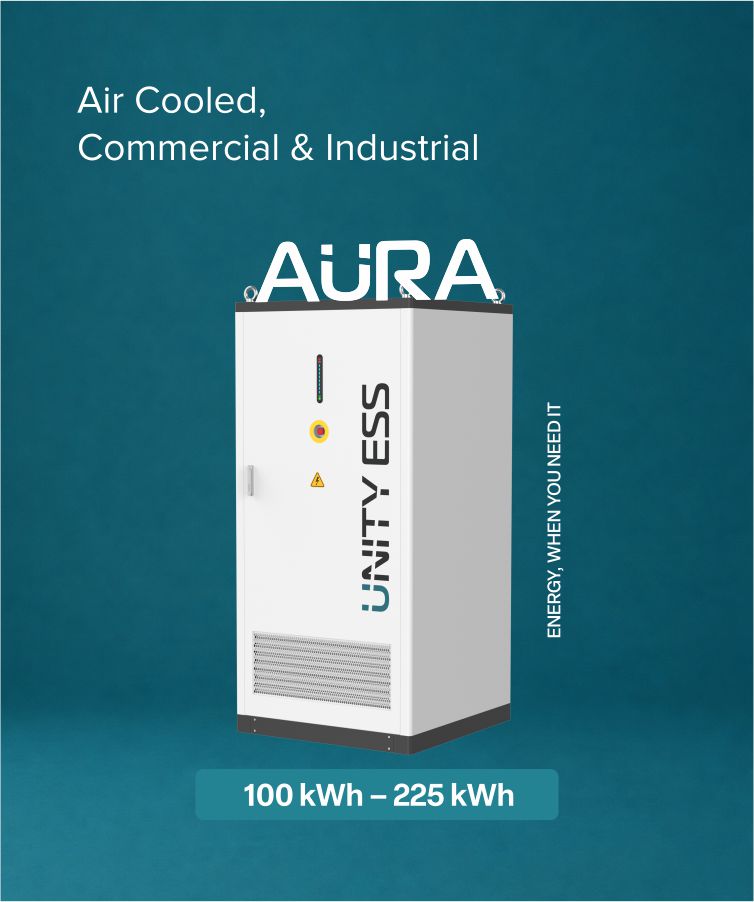
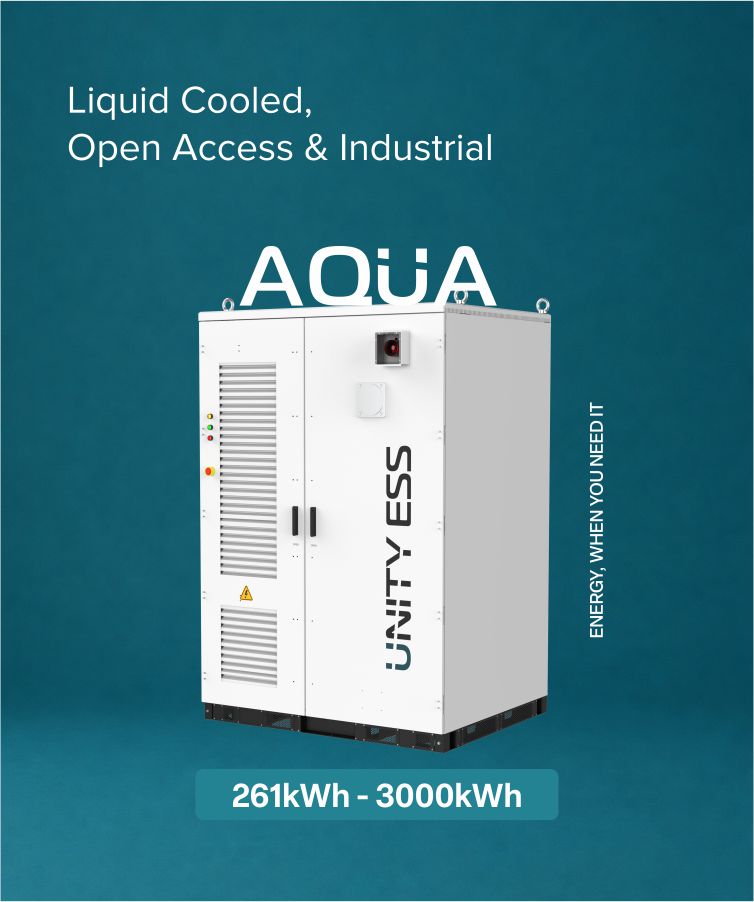
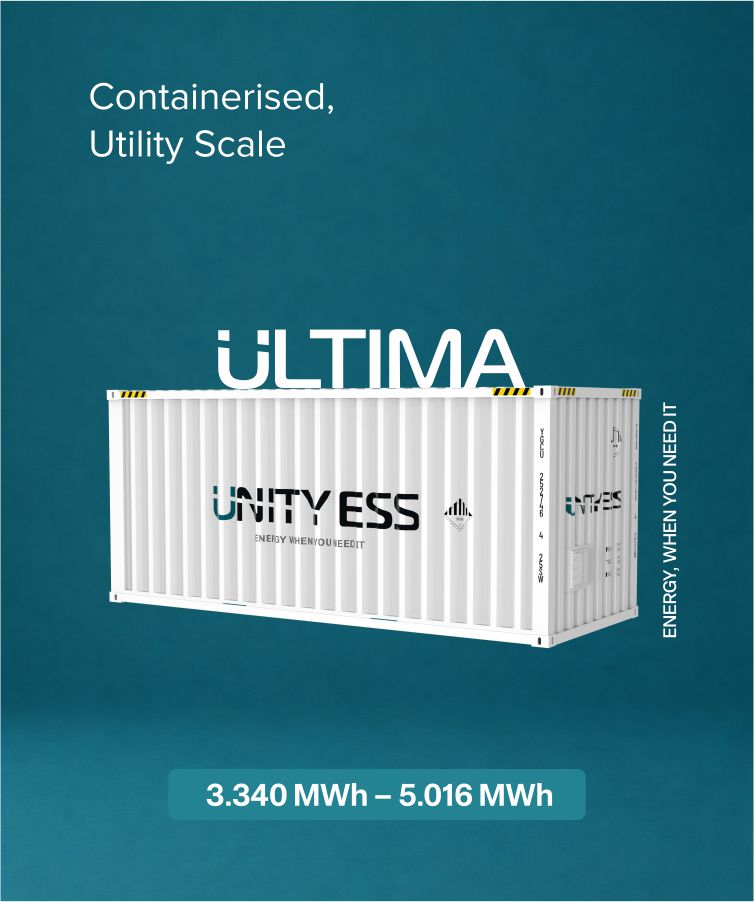
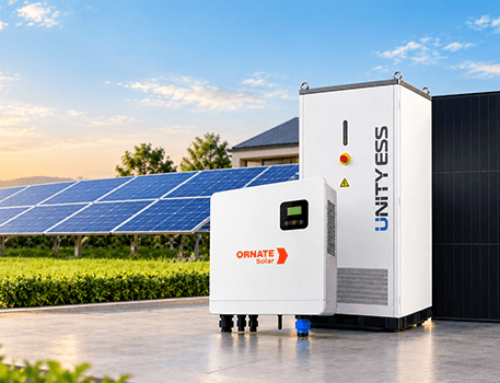
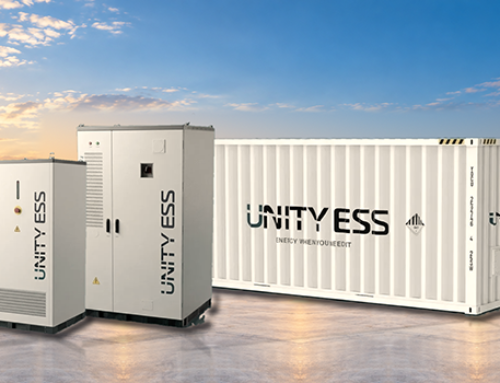
At UnityESS, this is exactly why our product families — Unity Aura (air-cooled, C&I), Unity Aqua (liquid-cooled, open access and industrial), and Unity Ultima (containerized, utility-scale) — are all built on LFP cells rated for 10,000 cycles, manufactured at our Ghiloth facility, and run on Unity EMS, our own energy-with-intelligence platform. It reflects our second brand pillar in practice: Proven Before Promised. Full specifications for each product line are available at www.unityess.ai.
FAQs
About Ornate Solar
Ornate Solar is a leading solar company with 10 years of experience in the industry and the mission to reimagine the way solar is installed worldwide.
By not only partnering with the best-in-class solar brands but also developing our high-quality solutions (panels, solar inverters, accessories, InRoof), we develop and deliver solutions that are modern, reliable, and effective.
Ornate Solar is also a trusted BESS manufacturer in India. We have developed UnityESS, an advanced energy storage solution to provide reliable power and energy independence.
If you are looking for high-quality solar solutions, call us at 1800 2026 252 to discuss your options.




Leave A Comment