

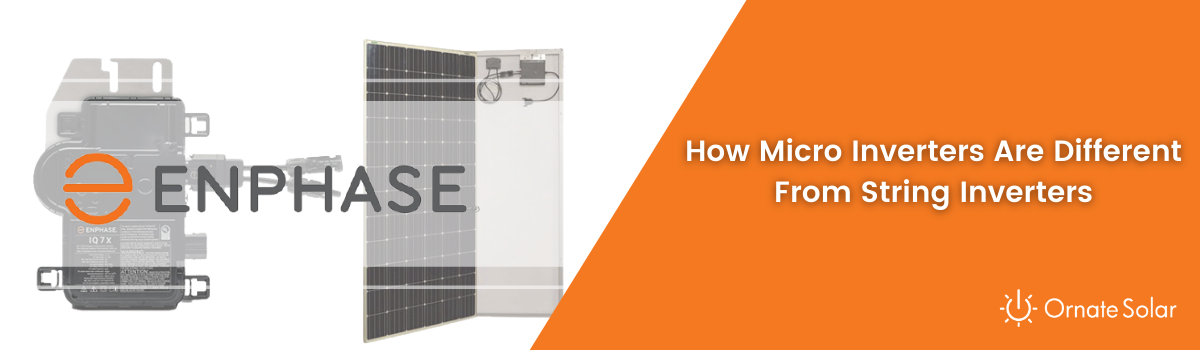
 Solar Micro Inverters
Micro inverters, if used properly then they can enhance the Indian solar rooftop industry. In a recent interview with PV Magazine, Mr. Sunil Thamaran, who is the India head of Enphase Inverters, explained the basic difference between the string inverters and the micro inverters. He also pointed out the issues due to which the Indian rooftop solar is not able to grow.
The growth rate of bipv solar roof in the Indian solar industry is very slow, which is a big challenge for the solution provider.
Mr. Sunil Thamaran pointed out 3 major issues in the Indian Solar Industry.
- Lack of Awareness
- Lack of Financial Solution
- Solar Developer Reliability
In the last 5 years, the Indian Solar industry has seen a lot of changes in policies. For example, previously, there was just net metering, but now there is also gross metering.
Now, the utility-scale solar developers have to show at least 10% of solar manufacturing capability as per the project size.
Due to these regular upgrades in policies, the solar developers are not able to create the required awareness, which is further affecting the solar adoption rate.
This is the very first problem for the Indian rooftop solar industry.
Further, Mr. Thamaran said that the solar market is a very capital-intensive market, and the lack of low-interest financial solutions has brought down the solar market. For a very long time, consumers have been facing the unavailability of finance at a lower rate.
If we saw last decade reports, the efforts have been made to grow the solar industry, but the same thing cannot be said about the financial solution for consumers. The financial institutions have failed to develop any mechanism that can help rooftop solar consumers.
The major factor that affects the rooftop solar market is the cost of the solar solution. The cost of the inverter affects the whole budget of solar solutions. The consumer always goes for the low-cost supplier, but these low-cost players cannot provide long-term reliability. Now, if the solution provider suggests the micro solar inverter in place of the string inverter, it will increase the budget of solar solutions as the cost of a micro inverter is higher than string inverter.
Micro inverters can indeed optimize the solar solution, but one cannot overrule the fact that micro inverters are costlier.
Although we cannot deny the cost factor, as the solar micro inverter is costlier than the string inverter which means the ROI (Return of Investment) period will be longer.
But the micro inverters are small and have less weight (around 1 kg), so easy to transport and install. It’s a plug-and-play kind of system. On the other hand, string inverters are very bulky and need to be handled with care at the time of transportation.
Continuing the conversation, Mr. Thamaran said, Enphase offers a warranty of up to 25 years on micro inverters to their consumers in India. Enphase also provides a continuous monitoring system that is available on the mobile app and also on the web. With the help of IoT, every consumer can log in and access it.
Now moving towards the performance of the solar inverter.
A major area of the Indian solar market is captured by string inverters. In a string solar inverter, all solar modules get connected with the help of a string, and this string is connected to the inverter box, which is a large-sized box. This box needs a big space to set up.
On the other hand, the micro inverter is connected right behind every solar module individually. So there is no need for any extra space for these inverters.
The micro inverter convert the solar power into AC form at the panel level & transfer it to a meter-box through a common wire. During the process, the DC to AC conversion of power is done at the module level, so, no high voltage DC travel in the system.
Now if we compare the solar micro inverter with the string inverter in terms of performance, the string inverter’s efficiency lies between 94% to 96%. In the case of solar micro inverters, it can be 98% or above.
To make you understand, let’s take an example. If the consumer has 15 solar panels, then every module has an individual solar inverter & the whole solution has 15 micro inverters. If one or two micro inverters are not performing well because of some reason, it will never affect the output of the whole solar solution. In other words, the power conversion is completed at the panel level, there are no power losses.
In the case of a string inverter, there is only one inverter for the whole solar solution. If the inverter fails to perform then the whole system will shut down. Besides this, in the string inverter, all panels are connected through a string, there are power losses in power transfer.
While talking about the challenges, Enphase and other micro inverter manufacturers are facing in India is catching up with the module technology roadmap. Solar panels are evolving, from 400 W to 500 W, and now even higher output. This means micro inverters needed to be compatible with the solar panels. This means that design and technology both needed to be upgraded regularly.
Enphase is coming up with the IQ8 inverter, which can be paired with 450-500W solar panels.
How Can We Help?
Hope this information about the micro inverters vs string inverters is helpful to you.
Ornate Solar is a leading solar company with 10 years of experience in the industry and the mission to reimagine the way solar is installed worldwide.
If you are planning to buy a solar micro inverter, you can connect with Ornate Solar to get the best prices on Enphase micro inverters. We are the official partner of Enphase India.
We have developed India’s first Solar roof system. Ornate InRoof is a roof made out of solar panels, which is leak-proof and looks aesthetically pleasing.
Ornate Solar is also a trusted BESS manufacturer in India. We have developed UnityESS, an advanced energy storage solution to provide reliable power and energy independence.
For more information, please give us a call at 1800 2026 252.



I was researching on this, thanks
1 kv full set cost?