

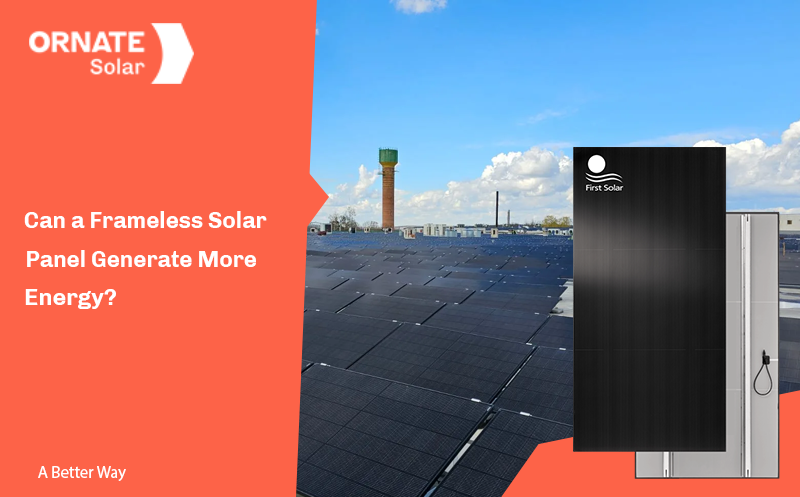
Yes, a frameless solar panel can generate more energy than a conventional framed solar panel. The absence of an aluminium frame helps reduce dust accumulation, improves rainwater runoff, minimizes corrosion risks, and supports better long-term performance. When combined with advanced technologies such as First Solar panels with Cadmium Telluride (CdTe) technology, frameless solar panels can deliver higher annual energy yield, particularly in hot climates like India.
What Is a Frameless Solar Panel?
A frameless solar panel has no aluminium border around its edges. Instead of an outer metal frame holding everything together, the solar cells are sealed between two layers of toughened, low-iron glass.
This glass-on-glass construction differs from how most conventional solar panels are built.
In a standard framed panel:
- Solar cells sit between a glass front sheet and a plastic backsheet
- An aluminium frame wraps the panel edges
- The frame can trap dust and water while adding weight to the module
In the First Solar Series 7 FT1:
- The module uses a glass-on-glass design
- There is no outer aluminium frame
- A galvanized steel mounting rail is attached to the rear of the module
The result is a durable solar panel designed to withstand challenging operating conditions while reducing some of the common causes of long-term performance loss.
Frameless Solar Panel vs Framed Solar Panel
| Feature | Frameless Solar Panel | Framed Solar Panel |
|---|---|---|
| Frame Material | None | Aluminium Alloy |
| Dust Accumulation | Lower | Higher |
| Rainwater Runoff | Better | Standard |
| Corrosion Risk | Lower | Higher |
| Durability | High (Glass-on-Glass) | Standard |
| Long-Term Performance | Better | Standard |
| Temperature Performance | Better with Thin-Film Technology | Standard |
| Maintenance Requirements | Lower | Moderate |
| Lifespan | 30+ Years | 25–30 Years |
Is a Frameless Solar Panel Available in India?
Yes.
One of the most prominent frameless solar panels available in India today is the First Solar Series 7 FT1, manufactured at First Solar’s facility in Sriperumbudur, Tamil Nadu.
The module is:
- Manufactured in India
- BIS certified
- ALMM enlisted
- Eligible for projects requiring domestic manufacturing compliance
This makes it suitable for large-scale commercial, industrial, and utility-scale solar projects across the country.
However, availability alone is not what makes the Series 7 FT1 noteworthy. Its ability to generate more energy in real-world operating conditions is what truly sets it apart.
How a Frameless Solar Panel Can Generate More Energy
The question is not whether removing the frame directly generates electricity.
The real question is whether a frameless design helps reduce the factors that lower energy production over time.
In many cases, the answer is yes.
1. Reduced Dust Accumulation
India’s solar installations face constant exposure to dust, pollution, bird droppings, and seasonal rainfall.
Traditional solar panels have frame edges that can trap debris and moisture. Over time, this buildup reduces the amount of sunlight reaching the active surface of the module.
The frameless Series 7 FT1 minimizes these collection points, helping rainwater wash away dust more effectively and reducing soiling-related energy losses.
2. Better Long-Term Durability
Conventional solar panels typically use plastic backsheets that are exposed to heat, UV radiation, and moisture for decades.
Over time, these materials can degrade and contribute to performance loss.
The Series 7 FT1 uses glass on both sides of the module, providing greater resistance to weathering and environmental stress while supporting long-term reliability.
3. Improved Performance in High Temperatures
Heat is one of the biggest challenges for solar projects in India.
In states such as Rajasthan, Gujarat, Andhra Pradesh, and Madhya Pradesh, module temperatures frequently exceed 55°C during summer afternoons.
The Series 7 FT1 combines frameless glass-on-glass construction with CdTe thin-film technology, which is less affected by heat than conventional silicon modules. This allows the panel to maintain stronger performance during periods of high solar irradiance and high temperatures.
4. Lower Long-Term Performance Losses
Many silicon solar panels experience performance losses caused by Light-Induced Degradation (LID) and Light and Elevated Temperature-Induced Degradation (LeTID).
These losses occur naturally as the module operates.
The Series 7 FT1 does not experience LID or LeTID, helping maintain its expected output from installation onward.
Why Technology Matters More Than the Frame
While frameless construction offers several benefits, the solar cell technology inside the panel ultimately has a greater impact on energy generation.
The First Solar Series 7 FT1 uses Cadmium Telluride (CdTe) thin-film technology instead of conventional crystalline silicon cells.
This provides several advantages:
- Better performance in high temperatures
- Stronger energy production in hot climates
- No silicon wafer-related cell cracking
- No LID or LeTID losses
- Lower long-term degradation
This combination of frameless construction and CdTe technology is what enables the Series 7 FT1 to deliver higher real-world energy yield.
Performance Advantages of the First Solar Series 7 FT1
The Series 7 FT1 features a warranted degradation rate of only 0.3% annually. As a result, the module retains more than 90.8% of its original output after 25 years.
Power Output: Up to 550W
With power ratings of up to 550W, the module reduces the number of panels, electrical connections, and installation activities required for large projects.
Zero LID and LeTID
Unlike conventional silicon modules, the First Solar panel Series 7 FT1 does not experience LID or LeTID losses, helping maintain expected performance from day one.
Higher Energy Yield in Hot Climates
The module’s CdTe thin-film technology performs exceptionally well in high-temperature environments, allowing it to generate more electricity under real operating conditions.
Ideal Use Cases for the Series 7 FT1
The First Solar panel Series 7 FT1 is specifically designed for:
Utility-Scale Solar Projects
Large solar parks and utility-scale installations can benefit from the module’s high energy yield, low degradation rate, and long-term durability.
Commercial and Industrial Ground-Mount Systems
Factories, warehouses, logistics parks, and industrial facilities can use the module to maximize energy production while reducing lifetime maintenance requirements.
Hot and Dusty Operating Environments
Regions with high temperatures, heavy dust exposure, and challenging weather conditions can benefit from the module’s frameless design and CdTe technology.
Common FAQs
Conclusion: Can a Frameless Solar Panel Generate More Energy?
Yes, a frameless solar panel can generate more energy over its lifetime.
The absence of a frame helps reduce dust accumulation, improve rainwater runoff, lower corrosion risks, and support better long-term performance.
However, the greatest gains come when frameless construction is combined with advanced module technology.
The First Solar panel pairs a frameless glass-on-glass design with CdTe thin-film technology, resulting in stronger performance in high temperatures, lower degradation, and higher real-world energy yield.
For developers focused on long-term energy production rather than laboratory efficiency ratings alone, frameless solar technology represents a compelling option for India’s rapidly growing solar market.
About Ornate Solar
Ornate Solar is a leading solar company with 10 years of experience in the industry and the mission to reimagine the way solar is installed worldwide.
By not only partnering with the best-in-class solar brands but also developing our high-quality solutions (panels, solar inverters, accessories, InRoof), we develop and deliver solutions that are modern, reliable, and effective.
Ornate Solar is also a trusted BESS manufacturer in India. We have developed UnityESS, an advanced energy storage solution to provide reliable power and energy independence.
If you are looking for high-quality solar solutions, call us at 1800 2026 252 to discuss your options.



Leave A Comment