

Voltage selection in Battery Energy Storage Systems (BESS) directly impacts efficiency, cost, and system design. Higher voltage reduces current, lowering cable size, copper usage, and energy losses. For optimal performance: use 415V for small systems (<200 kW), 800V for mid-size (200 kW–1 MW), and 690V for large systems (>1 MW).
Introduction
In Battery Energy Storage Systems (BESS), voltage is one of the most critical design decisions—yet it is often underestimated.
The voltage level at which a battery system connects to a facility determines how efficiently energy flows, how much infrastructure is required, and how cost-effective the system will be over its lifetime.
According to the UnityESS whitepaper, voltage selection is not arbitrary. It directly affects current, cable sizing, system losses, and overall project economics. Choosing the right voltage early in the design phase ensures better efficiency, lower costs, and a more scalable system.
What Does Voltage Mean in a BESS System?
Voltage defines how electrical power is delivered from the battery to the load or grid. For a fixed power requirement, voltage and current share an inverse relationship.
This means:
- When the voltage increases, the current decreases
- When the current decreases, losses and infrastructure reduce
This matters because high current leads to:
- Larger cables
- Higher heat losses (I²R losses)
- Bulkier and more expensive equipment
In simple terms, higher voltage allows the same power to flow more efficiently with less material.
Why Does Voltage Selection Matter So Much in BESS?
Voltage is not just a specification—it influences the entire system design.
At lower voltages, systems require higher current, which increases:
- Energy losses across cables
- Copper usage
- Installation complexity
At higher voltages, these challenges reduce significantly. Systems become more efficient, compact, and cost-effective over time.
However, higher voltage also introduces added complexity in insulation, safety, and component selection. That’s why the right choice depends on system size and application—not just efficiency alone.
What Are the Main Voltage Levels Used in BESS?
UnityESS focuses on three practical voltage levels used across real-world projects: 415V, 690V, and 800V. Each is suited to a specific system size and use case.
Key Features:
- No large upfront costs.
- Customer only pays for the energy generated.
- Solar service provider manages installation, maintenance, and operations.
415V — Best for Small Systems (<200 kW)
415V is the standard low-voltage level and works well for smaller installations where simplicity is key.
It integrates easily with existing infrastructure and avoids the need for additional transformers. However, as system size increases, current rises quickly, making the system less efficient.
For example, at higher power levels, current becomes very high, leading to bulky cables and higher losses.
Small commercial setups, retail spaces, and light industrial applications below 200 kW.
690V — Ideal for Large Systems (>1 MW)
690V is widely used in industrial and utility-scale environments. It offers a strong balance between performance and practicality for large systems.
At higher capacities, it provides efficient power delivery while maintaining manageable system complexity. It is particularly suitable where dedicated transformers and industrial infrastructure are already in place.
Where it works best:
Large industrial plants, utility-scale systems, and projects above 1 MW.
800V — The New Standard for Mid-Size Systems (200 kW – 1 MW)
800V is rapidly becoming the preferred choice for medium-scale BESS installations.
At this voltage, current reduces significantly compared to 415V, which leads to:
- Smaller cable sizes
- Lower copper costs
- Reduced energy losses
It also aligns well with modern battery configurations and evolving energy systems, making it a future-ready option.
Where it works best:
Commercial and industrial bess systems between 200 kW and 1 MW, especially where efficiency and scalability are important.
How UnityESS Models Align with These Voltage Levels
UnityESS products are designed to match these real-world voltage applications:
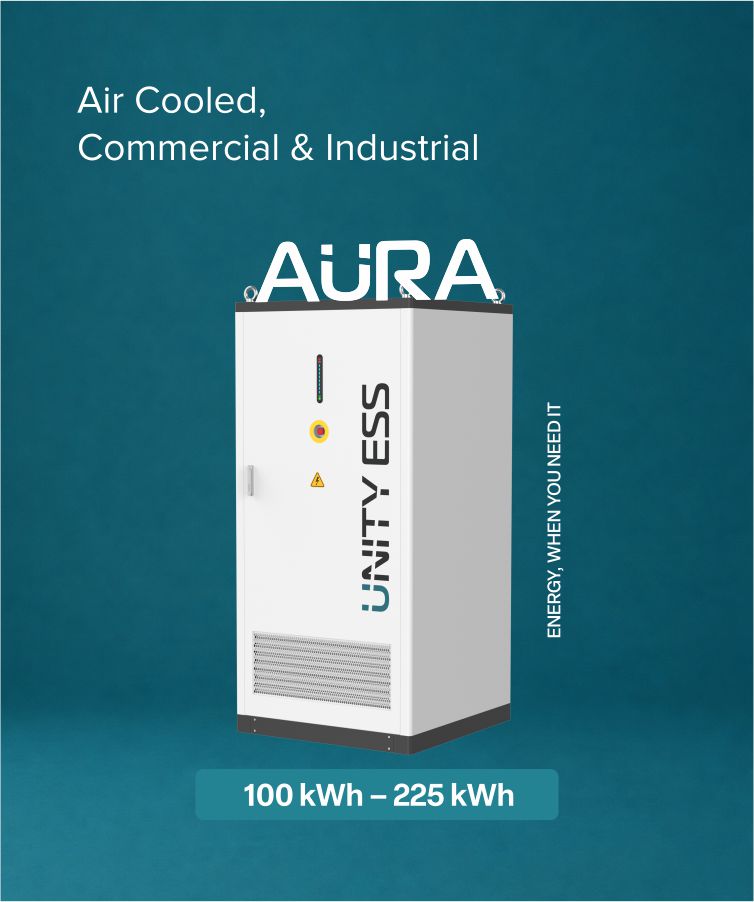
- UnityESS Aura runs at 415V — air-cooled, built for commercial and industrial sites like hotels, resorts, data centres, and CPOs where simple, direct integration matters most
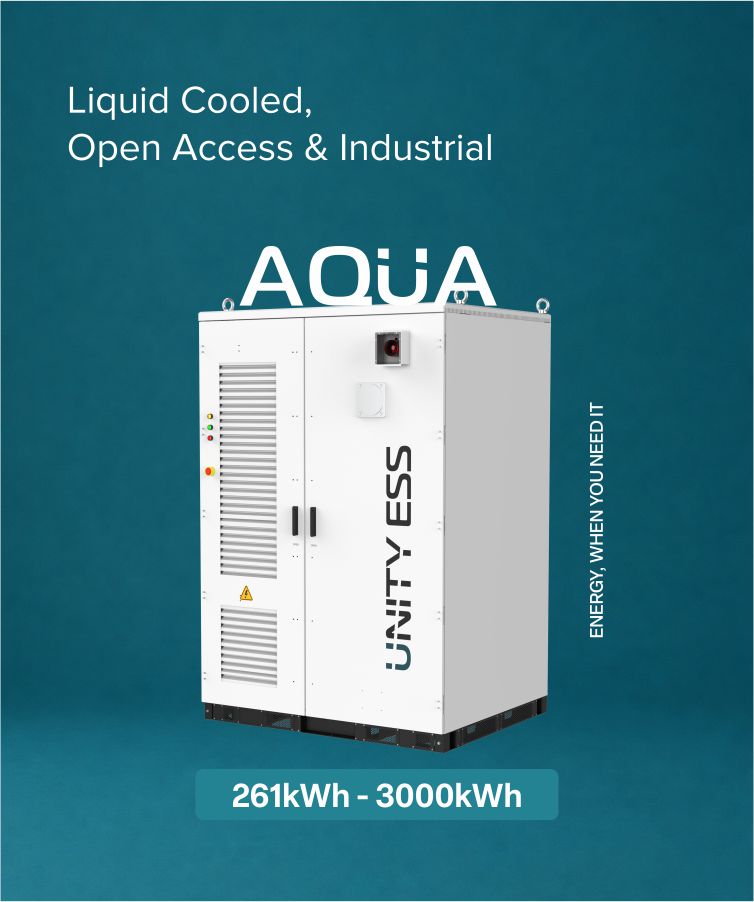
- Unity Aqua is liquid-cooled and spans 415V, 690V, and 800V (Aqua 4 / 6 / 8) — built to scale across industrial and open-access applications without forcing a single voltage tier
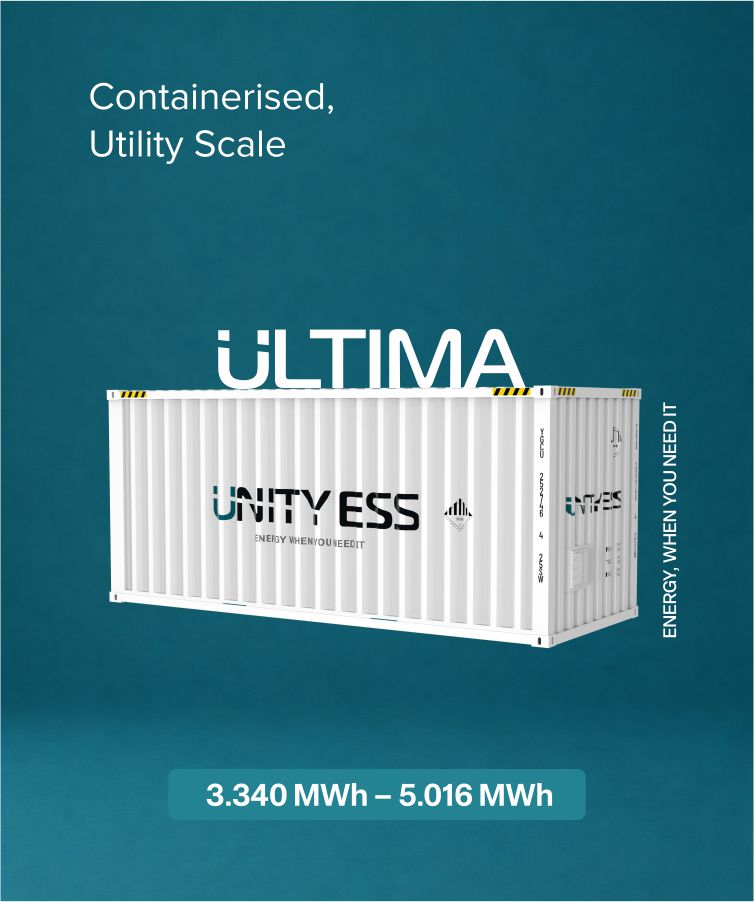
- Unity Ultima runs at 690V — containerized and built for utility-scale deployments: solar-plus-storage, grid frequency regulation, and IPP/EPC projects
This ensures each product is optimized for its intended use case rather than forcing a one-size-fits-all solution.
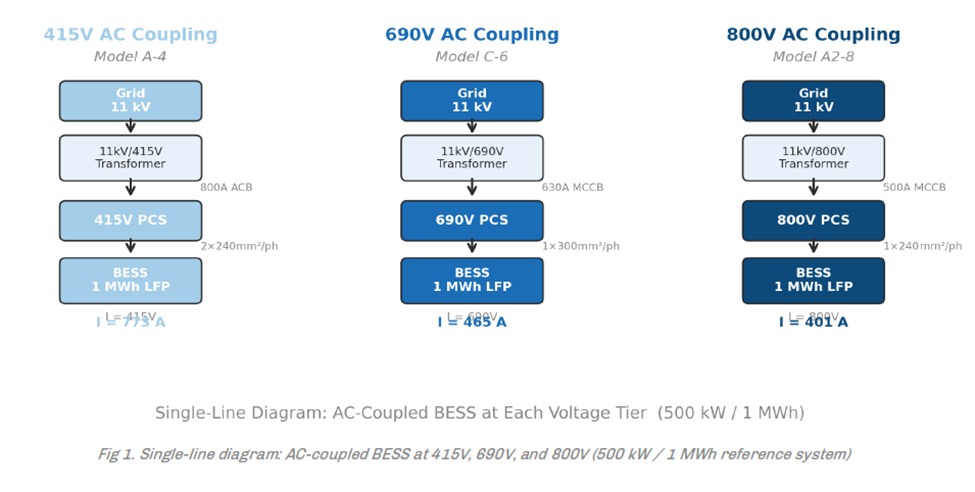
Visual Comparison of Voltage Architectures
As voltage increases, current decreases, which simplifies system design and reduces infrastructure requirements.
How Voltage Impacts Cost and Efficiency
| Parameter | 415V | 690V | 800V |
|---|---|---|---|
| Line Current | 773 A | 465 A | 401 A |
| Cable / Phase | 2 × 240 mm² | 1 × 300 mm² | 1 × 240 mm² |
| Total Cu (4-core) | 1,920 mm² | 1,200 mm² | 960 mm² |
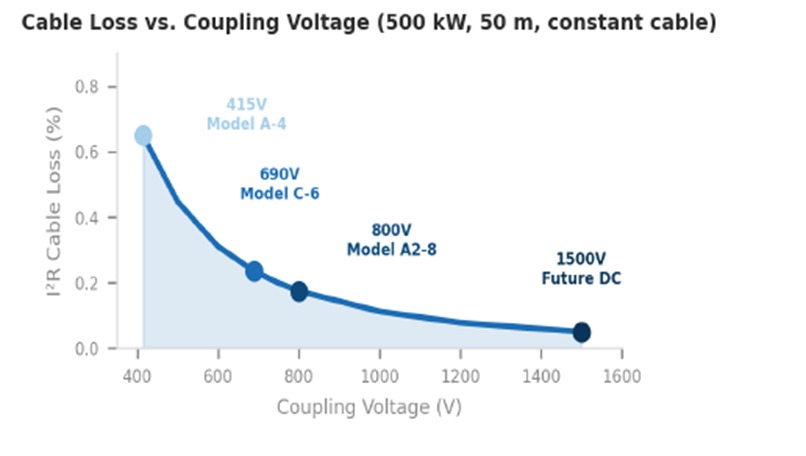
| I²R Loss (50 m) | 0.65% | 0.38% | 0.35% |
| Copper Cost | 100% | 63% | 50% |
| Switchgear | 800A ACB | 630A MCCB | 500A MCCB |
Copper cost indexed to 415V = 100%. At 800V, the system uses half the copper and loses 46% less energy in cable resistance compared to the 415V baseline.
This data clearly shows that higher voltage reduces both material cost and energy loss, improving overall system performance.
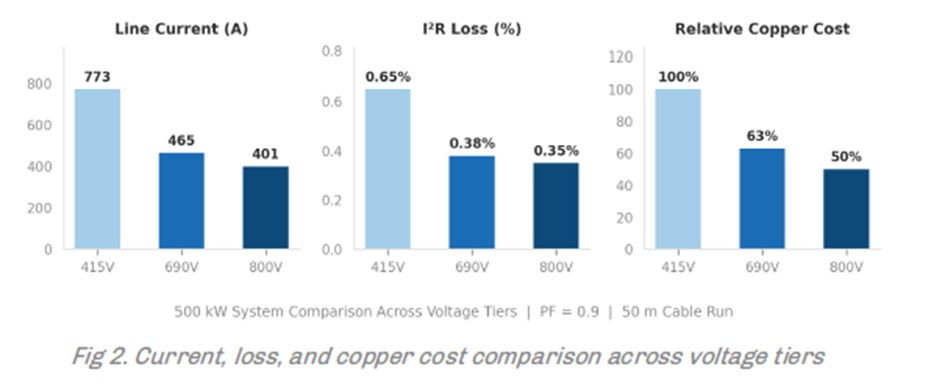
Performance and Cost Trends Across Voltage Levels
The charts highlight three critical trends:
- Current decreases sharply as voltage increases
- Cable losses drop significantly, improving efficiency
- Copper cost reduces, lowering overall system cost
This demonstrates that higher voltage systems are not just technically superior—they are also economically advantageous over time.
The Future: Moving Toward DC-Coupled Architectures
| Voltage | Wires | kW/mm² | vs 415 VAC |
|---|---|---|---|
| 415 VAC | 4 (P1, P2, P3, PE) | 0.6 | — |
| 690 VAC | 4 (P1, P2, P3, PE) | 1.0 | +67% |
| 800 VDC | 3 (POS, RTN, PE) | 1.7 | +157% |
| 1500 VDC | 3 (POS, RTN, PE) | 3.1 | +382% |
The natural progression of increasing voltage is the shift toward DC-coupled systems.
In these architectures, batteries connect directly to a DC bus (typically 1,000–1,500V), often shared with solar PV systems. This eliminates multiple AC/DC conversion stages, each of which introduces energy losses.
DC coupling improves round-trip efficiency and allows more power to be delivered through the same cable cross-section. For hybrid solar-plus-storage projects, this approach is especially effective because batteries can charge directly from solar without conversion losses.
As component technology evolves, DC-coupled systems are expected to move from niche applications to mainstream adoption.
Key Takeaways
Voltage selection is one of the most important decisions in BESS design because it directly affects efficiency, cost, and scalability.
Small systems under 200 kW work best at 415V due to simplicity. Mid-size systems between 200 kW and 1 MW benefit from 800V, which offers better efficiency and future readiness. Large systems above 1 MW are best suited to 690V, where performance and practicality are balanced.
UnityESS products—Aura, Aqua, and Ultima—are aligned with these voltage tiers, ensuring optimized performance across different applications.
Read More: White Paper: Why Voltage Levels Matter in Battery Energy Storage Systems (BESS)
Conclusion
Voltage is the foundation of an efficient Battery Energy Storage System. It determines how power flows, how much infrastructure is required, and how well the system performs over time.
By selecting the right voltage level and aligning it with the appropriate UnityESS model, businesses can build systems that are efficient, scalable, and cost-effective. As the industry evolves, this decision will continue to play a key role in shaping the future of energy storage.
About Ornate Solar
Ornate Solar is a leading solar company with 10 years of experience in the industry and the mission to reimagine the way solar is installed worldwide.
By not only partnering with the best-in-class solar brands but also developing our high-quality solutions (panels, solar inverters, accessories, InRoof), we develop and deliver solutions that are modern, reliable, and effective.
Ornate Solar is also a trusted BESS manufacturer in India. We have developed UnityESS, an advanced energy storage solution to provide reliable power and energy independence.
If you are looking for high-quality solar solutions, call us at 1800 2026 252 to discuss your options.






Leave A Comment