


BESS in India: Market Growth Data (2026)
India added 8.2 GWh of battery storage in the first half of 2026, against 98.4 MWh in the first half of 2025. Cumulative installed capacity reached 9.3 GWh by the end of June 2026, according to Mercom India Research. IESA’s latest market update puts operating capacity at 13.7 GWh in September 2026, about 17 times the December 2025 level. Read our coverage: India adds 8.2 GWh of new BESS capacity in H1 2026
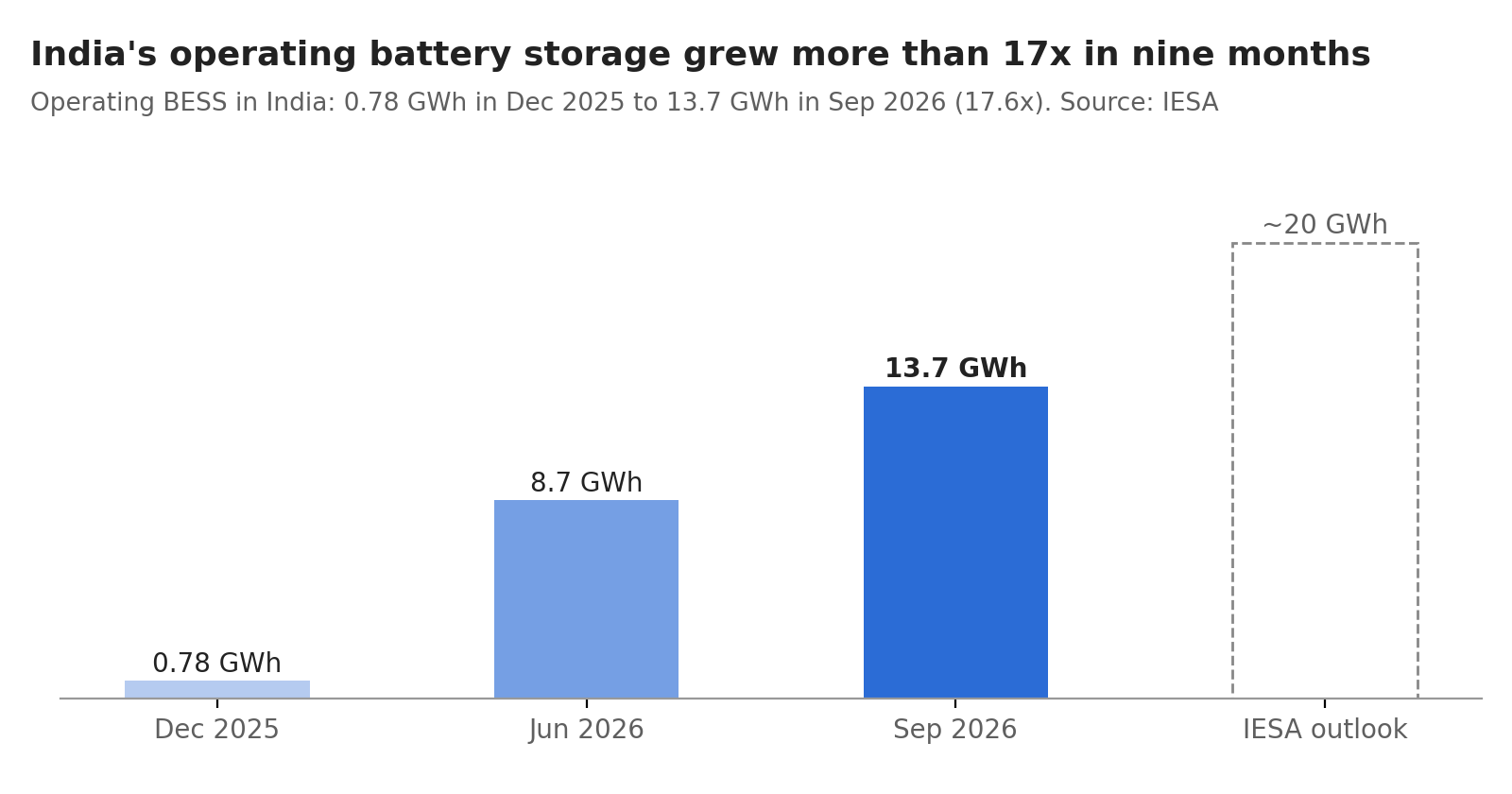
Source: IESA. 0.78 GWh (December 2025) and 8.7 GWh (June 2026) from the India BESS Market Review H1 2026; 13.7 GWh (September 2026) and ~20 GWh outlook from the IESA ESS Market Update, September 2026.
| Metric | Figure | Source (as of) |
|---|---|---|
| Operating BESS | 13.7 GWh | IESA (September 2026) |
| Cumulative installed BESS | 9.3 GWh | Mercom (end of June 2026) |
| BESS added in H1 2026 | 8.2 GWh | Mercom (June 2026) |
| Energy storage tendered since 2018 | 308 GWh (167 GWh BESS, 142 GWh pumped hydro) | IESA (September 2026) |
| Tendered capacity under execution / cancelled | 37% / 20% | IESA (September 2026) |
| Storage tendered in H1 2026 | 28 GW, of which about 9 GW auctioned | Mercom (June 2026) |
Mercom and IESA count slightly differently (installed vs. operational capacity), which is why their totals differ.
Key Growth Drivers and Market Trends
BESS in India grew faster in 2026 than in any year before. Operating battery storage rose from 0.78 GWh in December 2025 to 13.7 GWh in September 2026, according to the India Energy Storage Alliance (IESA). Six forces are driving that growth.
- Fast solar growth. Installed solar capacity reached 168.04 GW by 31 August 2026 (MNRE). Every GW of new solar adds midday supply that has to be used, stored or curtailed.
- Evening peak demand. Demand peaks after sunset, when solar output falls to zero. Storage moves daytime solar into those hours.
- Falling battery costs. Lower lithium-ion prices cut storage tariffs in Indian tenders by 86% between 2022 and 2025 (see the cost trend below).
- Government support. Viability Gap Funding, a transmission-charge waiver and storage obligations on utilities lower the cost and risk of new projects (see the policy section below).
- Market-based revenue. About 70% of the BESS capacity added in H1 2026 came from merchant projects that sell into power markets rather than under fixed government contracts (IESA). That opens the market to private investors.
- Domestic manufacturing. India’s lithium-ion cell manufacturing capacity is about 2 GWh today. IESA expects announced cell capacity to reach 60–70 GWh by 2030, and cell/pack-to-container assembly capacity 180–220 GWh.
For businesses comparing suppliers serving this market, see our list of BESS manufacturers in India.
How much storage India needs
The Central Electricity Authority’s National Electricity Plan projects that India needs 47.24 GW / 236.22 GWh of BESS by 2031–32. Including pumped hydro, the total requirement is 73.93 GW / 411.4 GWh. Looking further ahead, IESA projects India will need 888 GWh of energy storage by 2035–36 (read more).
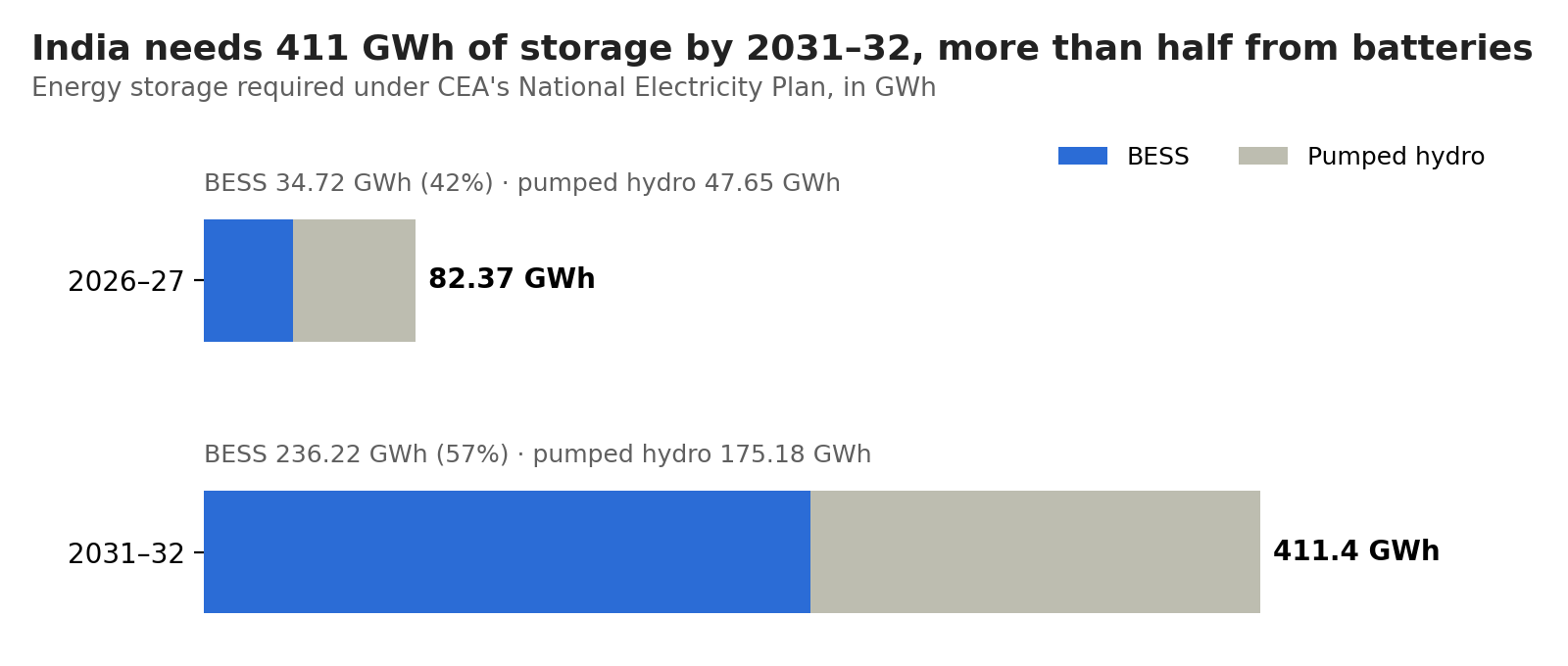
GW and GWh measure different things. GW is how much power a system can deliver at once; GWh is how much energy it can store. A 1 GW / 4 GWh system can deliver 1 GW for four hours.
What Is a Battery Energy Storage System (BESS)?
A battery energy storage system (BESS) stores electricity in rechargeable batteries and releases it when it is needed. Many stationary systems use lithium iron phosphate (LFP) cells, chosen for thermal stability and long cycle life; see our guide to LFP battery technology.
A BESS is more than a battery. Its main parts are:
- Battery modules and racks: store the energy.
- Battery management system (BMS): monitors each cell’s voltage and temperature and cuts off unsafe operation.
- Power conversion system (PCS): converts DC from the battery to AC for the grid or site, and back when charging.
- Energy management system (EMS): decides when to charge and discharge.
- Thermal management and fire protection: keep the system within safe operating temperatures.
For a full explanation of each part, read how a battery energy storage system works.
Challenges Facing BESS in India
India’s Energy Storage Market: Data & Growth Trends (2026)
Demand for storage is strong; turning tenders into working projects is the hard part. Of 308 GWh of energy storage tendered since 2018, including 167 GWh of BESS, 13.7 GWh of BESS was operating in September 2026 (IESA).
- Cancelled and stalled tenders. A project that wins a tender but has no signed power sale agreement struggles to raise finance. IESA reports that 20% of tendered storage capacity has been cancelled and 37% is under execution.
- Bids below viable levels. Some 2025 tariffs fell below IEEFA’s viability benchmark. Over a 12–15 year contract, a tariff must cover battery degradation, augmentation, replacement, financing and currency risk, not just the upfront cost.
- Import dependence. India’s lithium-ion cell manufacturing capacity is about 2 GWh today (IESA), so most cells are imported. EY notes that 60–70% of battery cost lies in materials, so local manufacturing has to go beyond cell assembly.
- Safety standards. EY recommends a unified national BESS safety code covering site layout, spacing, ventilation, fire protection and emergency response, so lenders and insurers can assess risk consistently. See how systems are protected in the 5 layers of BESS safety.
- Grid and transmission limits. India curtailed 8,133 GWh of solar generation between April and June 2026 (MNRE reply in Parliament). Storage absorbs part of that surplus, but transmission upgrades are needed alongside it.
Government Policies Driving BESS in India
Seven policy measures from the Union Cabinet, the Ministry of Power and the Central Electricity Authority (CEA) shape the market.
| Metric | 2026 Update | Impact |
|---|---|---|
| Operational BESS Capacity | 1.2 GWh (approx., verify against latest internal/industry tracking) | Rapid deployment across renewable projects |
| Energy Storage Tenders | 200+ GWh project pipeline | Major projects concentrated in Rajasthan and Gujarat |
| Key Deployment States | Gujarat, Rajasthan, Karnataka, Maharashtra, Andhra Pradesh | Expanding regional renewable energy hubs |
| Long-term BESS target | 80 GW / 321 GWh by 2035‑36 (CEA) | Anchors India’s grid-scale storage roadmap |
What the draft would mean in practice: a 100 MW solar plant commissioned after July 2027 would need at least 10 MW / 20 MWh of storage. One commissioned between July 2029 and June 2031 would need 10 MW / 40 MWh.
Amendments to the Electricity Rules also allow individual consumers to develop, own, lease or operate energy storage systems, which opens storage to businesses as well as utilities. Read our earlier coverage of 2-hour energy storage for new solar projects.
Why BESS Is Essential in India
Solar made up 29.54% of India’s installed power capacity at the end of June 2026 (CEA), yet it met only 9.4% of electricity demand in 2025 (Ember). A solar plant produces only in daylight, so each GW of solar delivers far fewer units over a day than a GW of coal running round the clock. Storage is how India uses more of the solar it builds.
- Managing intermittency. Solar and wind output changes with sunlight and wind. A BESS stores the surplus and supplies it when generation drops, so the grid sees a steadier supply.
- Using solar in the evening peak. Demand peaks after sunset. Storage shifts midday solar into those hours instead of curtailing it.
- Grid stability. A BESS responds in milliseconds to seconds, so it can provide frequency regulation and voltage support as the share of solar and wind rises.
- Replacing diesel backup. Many factories run diesel generators during outages. A BESS charged from solar or off-peak grid power can cover those hours with lower running costs and no on-site emissions. Compare the two in solar battery vs generator.
- Cutting peak-hour costs for businesses. Where time-of-day tariffs apply, a BESS lets a site draw stored energy during expensive peak hours. See BESS for C&I consumers.
- Getting more from open access and captive solar. Storage lets businesses keep surplus contracted green power for later use instead of losing it. See battery storage for open access users.
- Microgrids for remote areas. Solar plus BESS can run a microgrid where the grid is weak or absent.
- Storage built into new plants. CEA already advises 2-hour co-located storage in solar tenders, and its September 2026 draft would make it a requirement from July 2027 (see the policy section above).
BESS Cost Trend in India
Standalone BESS tariffs in India fell 86% between 2022 and 2025, then rose again in 2026. Most utility storage tenders pay a fixed capacity charge in ₹ lakh per MW per month, whether or not the stored energy is used, so these tariffs are the clearest public price signal.
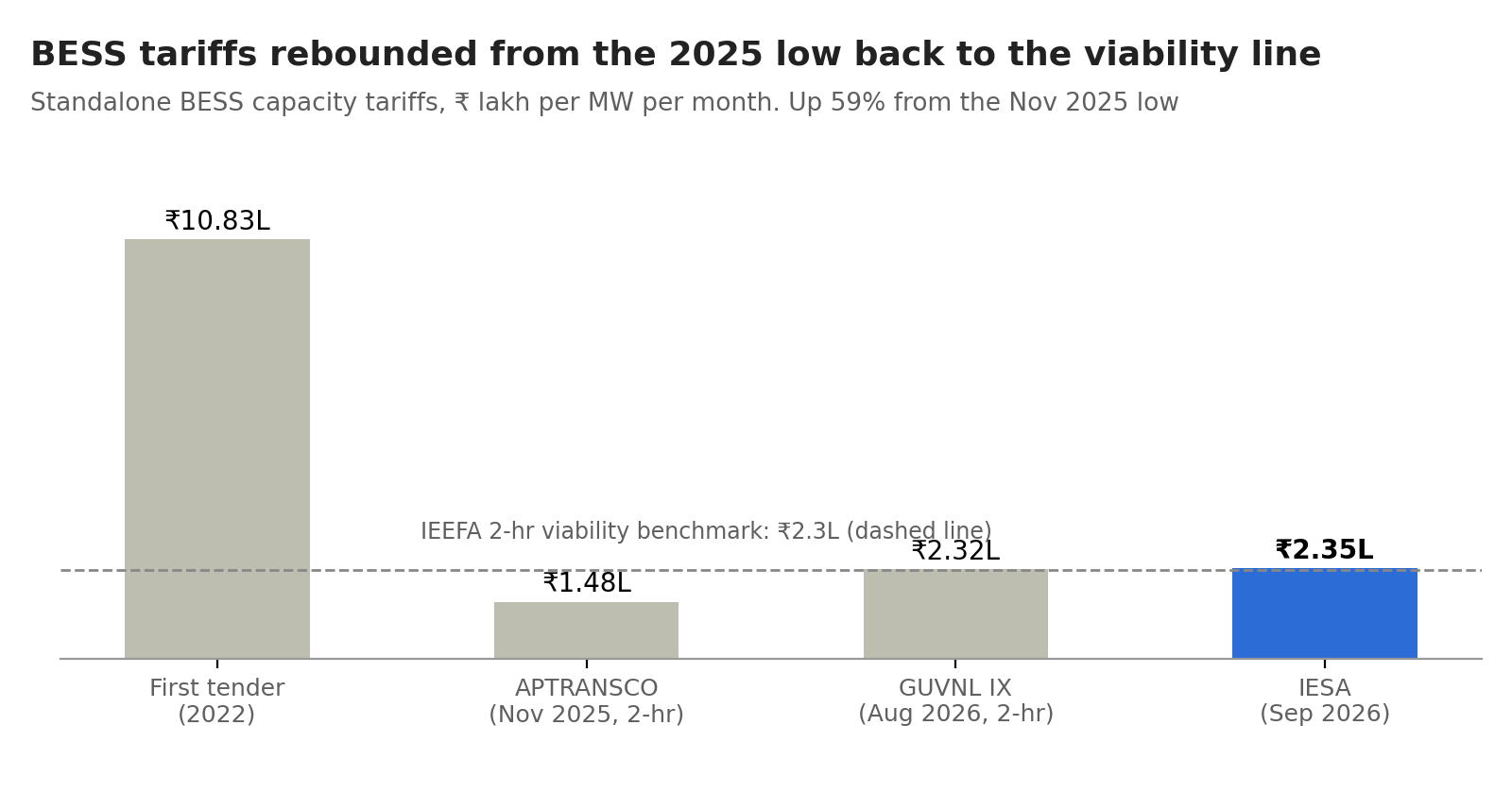
Sources: EY India (2022), IEEFA (2025 low, 2-hour benchmark), PV Magazine India (GUVNL Phase IX), IESA ESS Market Update September 2026 via Energy-Storage. news. 4-hour tenders are priced higher and are not shown.
- 2022: India’s first standalone BESS tender discovered ₹10.83 lakh/MW/month (EY).
- 2025: the lowest 2-hour tariff fell to ₹1.48 lakh/MW/month (APTRANSCO, November 2025), below IEEFA’s 2-hour viability benchmark of ₹2.3 lakh.
- August 2026: GUVNL’s Phase IX tender for 450 MW / 900 MWh discovered ₹2.32 lakh/MW/month. By September 2026, IESA put standalone tariffs at ₹2.35 lakh/MW/month, about 59% above the 2025 low.
Why costs are rising again. Industry reports point to higher battery and raw-material prices, changes in Chinese export policy and currency swings, since most cells are imported. EY estimates that a 10% exchange-rate movement shifts the minimum bankable tariff by about 8.3%.
What this means for businesses. Utility tender tariffs are a market signal, not a quote for a factory or commercial building: C&I systems are sized and priced per site. Owning the system (CAPEX) or paying for it as a service (OPEX) changes the upfront cost; compare both in BESS financing: CAPEX vs OPEX.
Choosing the Right BESS Solution
Before buying a BESS for a factory, commercial building or solar plant, check five things:
- Capacity and duration: kW sets how much load the system can carry; kWh sets for how long. Size both from your load data and tariff structure.
- Integration: compatibility with your solar inverters and site voltage. See why voltage levels matter in BESS.
- Energy management software: the EMS decides when to charge and discharge, which drives the savings.
- Safety and battery life: cell chemistry, BMS, thermal management, fire protection and warranted cycle life.
- Supplier support: design, commissioning, monitoring and service.
For the full checklist, read things to know before buying a battery storage system in India. To see a working example, read how Ornate commissioned a 7 MWh multi-site UnityESS project in Rajasthan.
The Future of BESS in India
The next milestones are already set. IESA reported 13.7 GWh of operating BESS in September 2026 and expects close to 20 GWh in the coming months. Green Energy Corridor Phase III adds 50 GWh of BESS by FY 2032–33. CEA’s draft regulations would require storage at new solar and wind plants from July 2027. The CEA National Electricity Plan calls for 236.22 GWh of BESS by 2031–32, and CEA projects total storage needs of 2,380 GWh by 2047, of which 1,840 GWh would be BESS.
FAQ: Battery Energy Storage Systems in India
Conclusion
BESS in India has moved from pilots to grid scale: 13.7 GWh operating by September 2026, 308 GWh of storage tendered since 2018, and a CEA target of 236.22 GWh of BESS by 2031–32. The case for storage is clear from India’s own grid. Solar is about 30% of installed capacity but under 10% of generation, and storage is what lets that solar serve the evening peak.
The constraints are execution, not demand: tender cancellations, bids below viable levels, imported cells and the need for common safety standards. For businesses, falling and now stabilising costs, consumer ownership rules and time-of-day tariffs make storage worth evaluating today.
About Ornate Solar
Ornate Solar is a leading solar company with 10 years of experience in the industry and a mission to reimagine solar installation worldwide.
By partnering with best-in-class solar brands and developing high-quality solutions (solar inverter, accessories, InRoof), we deliver solutions that are modern, reliable, and effective.
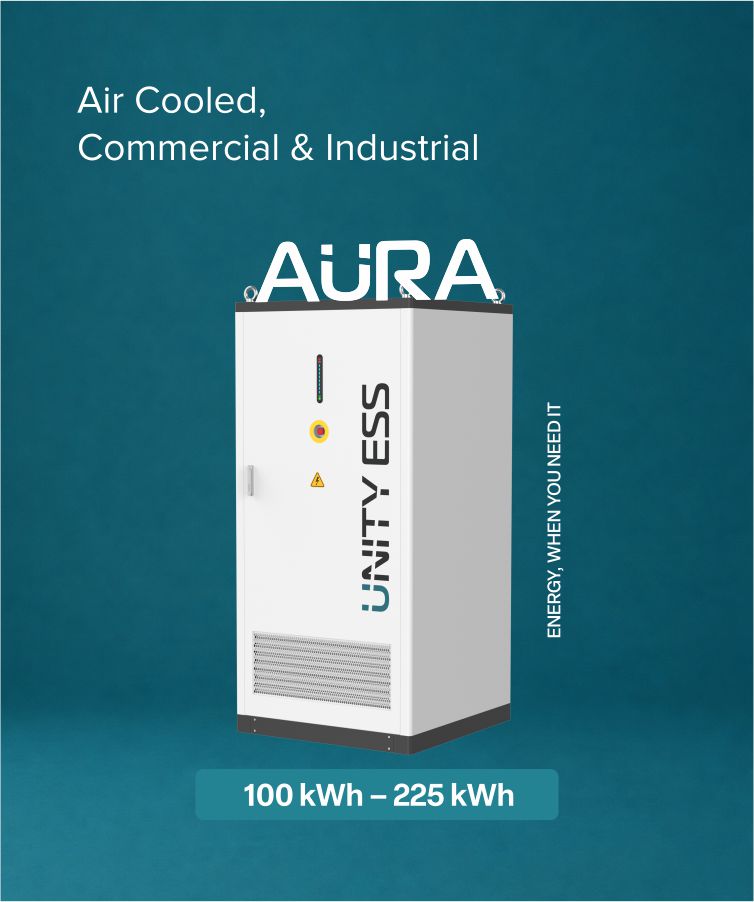
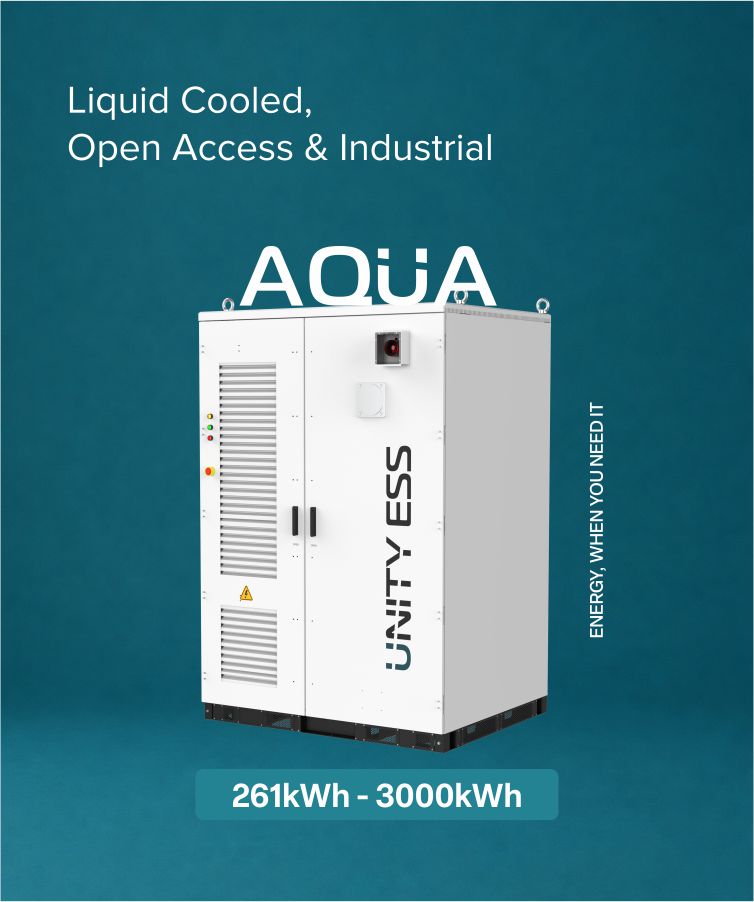
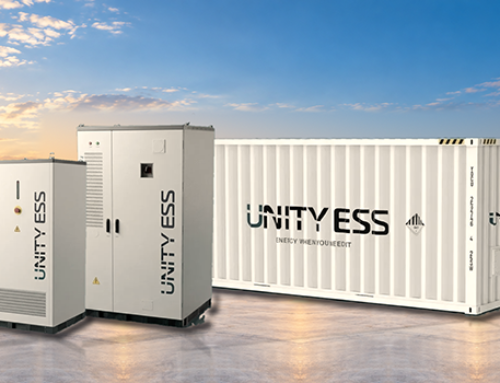
Ornate Solar is also a trusted BESS manufacturer in India. We have developed Unity ESS, an advanced energy storage solution to provide reliable power and energy independence.
If you are looking for high-quality solar inverter solutions, reach out to us at 1800 2026 252 to discuss your options.



Add Happiness to Every StepPanelInverterDream
Search For Solar PanelsInvertersAccessoriesNewsAnything !
We have everything you require to make your solar project more efficient, reliable and profitable. So go ahead search for anything solar.

This was a very helpful article! The way you explained how battery energy storage systems support renewable power in India was easy to understand. BESS is definitely becoming important for reliable backup, grid stability, and better use of solar energy. Thanks for sharing this!